

Small satellites are changing the way spacecraft are designed, manufactured, launched, and operated.
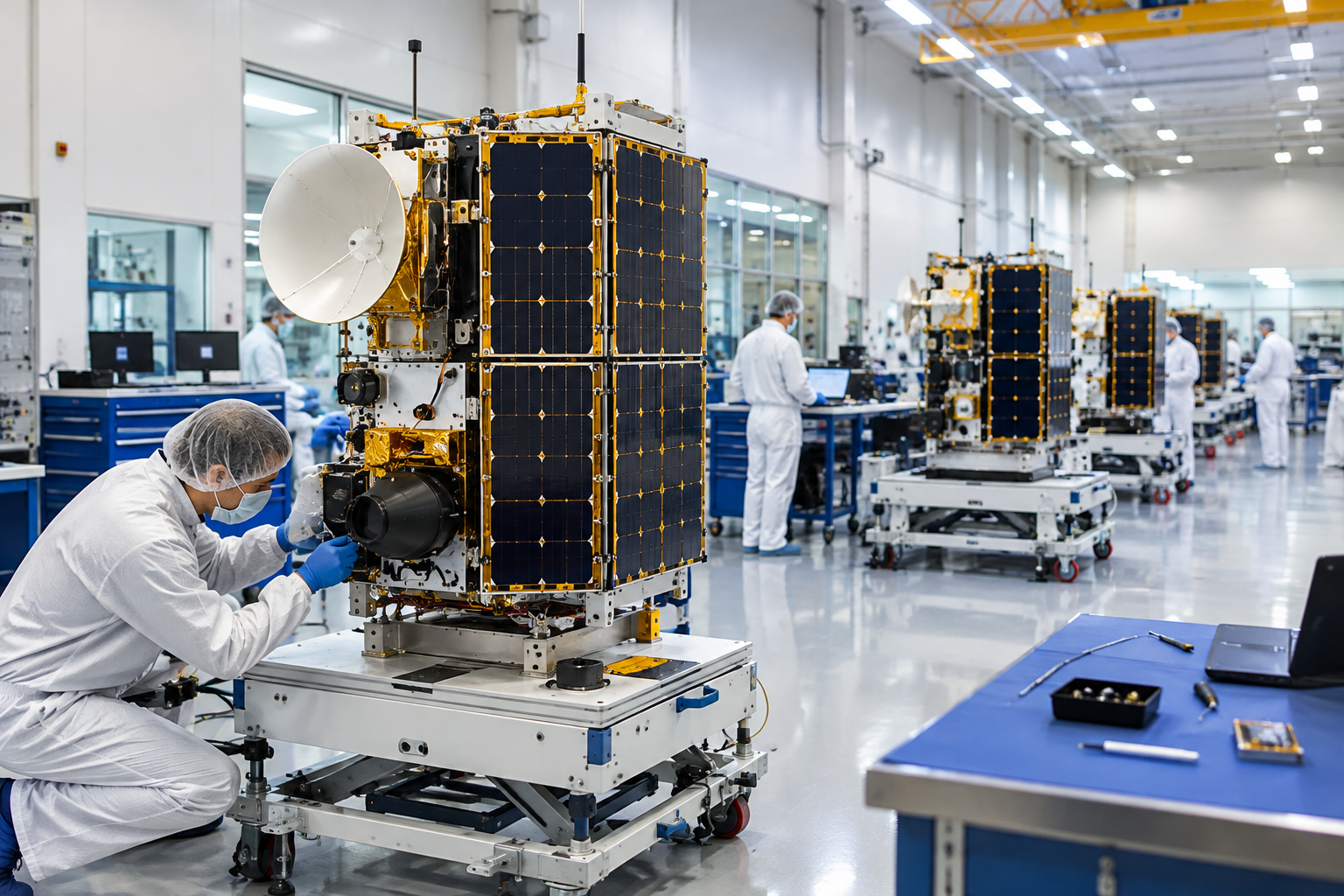
Instead of building every satellite as a one-off project that takes years to develop, the space industry is increasingly moving toward standardized spacecraft, reusable components, mass production, and flexible satellite platforms.
Rocket Lab is one of the companies pursuing this approach.
The company is widely known for its Electron rocket, but its ambitions extend well beyond launching small payloads. Through its Space Systems business, Rocket Lab develops spacecraft platforms, satellite components, flight software, propulsion systems, and complete satellite solutions.
At the center of this strategy is Photon, a configurable spacecraft platform designed to support different payloads and missions. Rocket Lab is also producing spacecraft for large constellations, including communications and defense programs.
The result is a different way of thinking about small satellites: rather than treating every spacecraft as a completely new engineering project, many missions can be built around common technologies and production systems.
Article Focus and SEO Information
- Primary topic: Rocket Lab’s small-satellite manufacturing and spacecraft technology
- Search intent: Informational
- Primary keyword: Rocket Lab small satellites
- Secondary keywords: Rocket Lab satellites, Photon spacecraft, Rocket Lab Space Systems, small satellite technology, satellite manufacturing, Electron rocket, satellite constellations, spacecraft platforms, small spacecraft
- Important verification points: Current production numbers, contract status, launch schedules, and future Neutron capabilities can change. Any future-looking claims should be updated before publication.
Why Small Satellites Are Becoming More Important
Satellites have traditionally been large, expensive, highly customized machines.
That approach still makes sense for some missions. A spacecraft traveling to another planet, operating a huge Earth-observation instrument, or supporting a major communications system may require specialized hardware.
But not every mission needs a massive spacecraft.
Advances in electronics, sensors, communications, propulsion, computing, and manufacturing have made it possible to build capable spacecraft in much smaller packages.
Small satellites can be used for:
- Earth observation
- Communications
- Scientific research
- Technology demonstrations
- Navigation and tracking
- Weather and environmental monitoring
- National security missions
- Deep-space exploration
The challenge is no longer simply making a satellite smaller. Engineers also need to make small spacecraft reliable, manufacturable, maneuverable, and affordable enough to deploy in larger numbers.
That is where Rocket Lab’s spacecraft business becomes particularly interesting.
Rocket Lab Is More Than a Rocket Company
Rocket Lab began as a launch company built around the Electron rocket, but it has expanded into a much broader space-technology business.
Its Space Systems operations include spacecraft platforms, satellite components, software, and spacecraft manufacturing.
The company’s approach is effectively an end-to-end model: a customer can obtain a spacecraft platform, components, launch services, and other mission support from the same company.
Rocket Lab has described this strategy as “space systems” alongside its launch business. Its satellite offerings include the Photon spacecraft as well as larger-scale spacecraft production programs. RRocket Lab+1
This matters because satellite operators increasingly need more than a rocket.
They need the spacecraft itself, propulsion, power, communications, flight software, ground systems, testing, and eventually a way to operate the satellite.
What Is the Photon Spacecraft?
Photon is Rocket Lab’s modular spacecraft platform.
In simple terms, a spacecraft bus is the part of a satellite that provides the basic systems needed to operate a mission. These can include power, communications, computers, thermal control, attitude control, and propulsion.
The customer then adds the equipment needed for its particular mission.
Rocket Lab describes Photon as a configurable platform designed to accommodate different payloads and instruments without requiring major spacecraft redesigns. The platform can also operate as an independent spacecraft while carrying another payload. RRocket Lab
That flexibility is important for smaller missions.
Instead of starting the spacecraft design process from zero, engineers can use an established platform and concentrate more of their effort on the mission-specific payload.
Photon Can Go Beyond Low Earth Orbit
One of Photon’s notable features is that it is not limited to ordinary low-Earth-orbit missions.
Rocket Lab’s documentation describes Photon configurations for missions beyond 2,000 kilometers, including medium Earth orbit, lunar, and interplanetary destinations. The spacecraft includes radiation-tolerant avionics, deep-space-capable communications and navigation technology, and restartable propulsion. RRocket Lab
Photon has already demonstrated its usefulness beyond conventional Earth orbit.
For NASA’s CAPSTONE mission, Rocket Lab used Photon as the spacecraft bus supporting the spacecraft after Electron’s initial launch. Photon provided propulsion, communications, power, and attitude-control functions during the early stages of the mission and used its HyperCurie engine to help send CAPSTONE toward the Moon. RRocket Lab
That mission showed that a relatively compact commercial spacecraft platform could support a deep-space mission.
Why a Standardized Spacecraft Platform Matters
Building satellites from a common platform can change the economics and schedule of spacecraft development.
Imagine two companies developing satellites with similar basic requirements.
If both start with completely different spacecraft designs, they each have to develop and test many of the same underlying systems.
A standardized platform can provide those common functions in advance.
The customer can then concentrate on the payload.
This does not eliminate engineering work. Every mission still has different requirements, environments, interfaces, and testing needs.
But using a common platform can reduce the amount of hardware that needs to be designed from scratch.
Rocket Lab has described Photon as part of a “satellites as a service” model in which customers can obtain spacecraft, launch, ground services, and on-orbit management as an integrated package. RRocket Lab
Rocket Lab Is Also Building Satellites in Larger Numbers
Photon represents the flexible spacecraft-platform side of Rocket Lab’s strategy.
The company is also involved in production of multiple spacecraft for satellite constellations.
This is important because constellations require a different manufacturing philosophy from traditional one-off spacecraft.
A constellation may require dozens or hundreds of spacecraft with similar architectures. The engineering challenge shifts from building one highly customized satellite to building many reliable spacecraft efficiently.
Rocket Lab has developed production capabilities for this market.
The Globalstar Satellite Program
Rocket Lab has been involved in producing spacecraft buses for a next-generation Globalstar communications constellation.
In a 2024 investor update, Rocket Lab said it had a $143 million subcontract with MDA to build 17 spacecraft buses for the Globalstar constellation. The company reported that it had completed an integration-readiness review, powered on the spacecraft bus, and delivered its first customer full flat-satellite configuration at that stage of the program. RRocket Lab Corporation
The program demonstrates why standardized spacecraft manufacturing matters.
Instead of engineering an entirely new spacecraft for every satellite, manufacturers can establish repeatable production processes and build multiple spacecraft around a common design.
Rocket Lab’s Scorpius Spacecraft Program
Rocket Lab has also been selected by the U.S. Space Development Agency for the Scorpius program.
Rocket Lab reported a $515 million prime contract to build 18 spacecraft for the program. The company said the program had completed its System Requirements Review and System Design Review and had major payload and subcontractor suppliers under contract in its 2024 update. RRocket Lab Corporation
The Scorpius work illustrates another part of the company’s satellite strategy: applying commercial-style spacecraft production to government constellation programs.
Because the exact production and delivery status can change over time, current program milestones should be checked against the latest Rocket Lab and U.S. government announcements before publication.
The Components Matter Too
Rocket Lab’s satellite strategy does not stop at complete spacecraft.
The company has expanded into individual satellite components and subsystems through acquisitions and internal development.
These can include technologies such as:
- Reaction wheels
- Star trackers
- Radios
- Solar-power systems
- Separation systems
- Flight software
- Guidance and control systems
Rocket Lab has previously described this expansion as building a broader portfolio of space-system technologies rather than relying only on launch services. RRocket Lab
This is significant because satellite manufacturers need dependable components just as much as they need a spacecraft structure.
What Are Reaction Wheels?
A reaction wheel is a spinning device inside a spacecraft that helps control its orientation.
By changing the wheel’s rotational speed, a spacecraft can rotate without continuously firing thrusters.
That is particularly useful for satellites carrying cameras or other instruments that need to point accurately at Earth or another target.
Rocket Lab acquired Sinclair Interplanetary, whose products included satellite components such as reaction wheels and star trackers. Rocket Lab has subsequently described components as part of its wider Space Systems portfolio. RRocket Lab
What Are Star Trackers?
A star tracker is essentially an optical navigation sensor for spacecraft attitude.
It observes stars and compares their positions with an onboard star catalog to determine how the spacecraft is oriented.
That information can help a satellite point its instruments or communications antennas accurately.
For a modern small satellite, precise attitude control is important because even a compact spacecraft may carry cameras, radar, communications equipment, or scientific instruments that require accurate pointing.
Rocket Lab Is Building the Software Side Too
Modern satellites are not just hardware.
They are increasingly software-defined machines that need to process sensor data, control spacecraft systems, manage communications, and respond to changing conditions.
Rocket Lab’s space-software portfolio includes MAX Flight Software, a commercial flight-software system developed to support aerospace vehicles.
Rocket Lab’s software documentation also describes InterMission, a ground software platform designed for spacecraft monitoring, telemetry, mission operations, and constellation-scale operations. RRocket Lab
This gives Rocket Lab another part of the satellite-development stack.
A customer can need a spacecraft structure, propulsion, avionics, flight software, ground software, and launch service. Having multiple pieces of that chain under one company can simplify some mission architectures.
Why Constellation Manufacturing Is Different
Building one satellite is fundamentally different from building dozens.
For a single spacecraft, engineers can spend a large amount of time optimizing individual components.
For a constellation, manufacturers have to think about:
- Production throughput
- Repeatability
- Supply chains
- Component availability
- Automated testing
- Quality control
- Assembly procedures
- Software configuration
- Satellite acceptance testing
The goal is not simply to build the spacecraft quickly.
Every satellite has to perform reliably because a constellation’s overall performance can depend on many spacecraft operating together.
Rocket Lab’s move into constellation production reflects this larger industry trend toward spacecraft manufacturing at scale. Its investor materials have described production lines capable of producing satellites for constellation and bespoke programs. RRocket Lab Corporation
How Electron Fits Into the Strategy
Rocket Lab’s satellite business is closely connected to its launch business.
The Electron rocket was developed specifically for small payloads and has become Rocket Lab’s primary small-launch vehicle.
This creates a useful combination.
Rocket Lab can develop a spacecraft, integrate the payload, and provide a launch opportunity rather than leaving the customer to coordinate every part of the process with different companies.
For some missions, Rocket Lab’s Photon can also remain attached to or operate alongside the customer’s payload after launch, providing additional spacecraft functions. RRocket Lab
That is different from a conventional launch service in which the rocket’s job ends once the satellite is delivered to its target orbit.
What About Neutron?
Rocket Lab is also developing Neutron, a larger reusable launch vehicle.
Neutron is intended to expand Rocket Lab’s ability to launch larger payloads and support missions beyond the capabilities of Electron.
However, Neutron should be treated as a development program, not as an operational launch vehicle.
Its future role could become important for constellation deployment and larger spacecraft, but launch schedules and capabilities should be checked against Rocket Lab’s latest announcements before publication.
Why This Matters for Small Satellite Technology
The most important development may not be a single spacecraft design.
It is the move toward an integrated space manufacturing ecosystem.
Rocket Lab is working across several layers:
- Launch: Electron provides dedicated small-payload launch capability.
- Spacecraft: Photon provides a modular spacecraft platform.
- Components: Rocket Lab supplies or develops spacecraft subsystems.
- Software: Flight and ground software support spacecraft operations.
- Constellations: Larger production programs demonstrate repeatable spacecraft manufacturing.
- Deep space: Photon has supported missions beyond Earth orbit.
Together, these capabilities point toward a future in which building and operating a satellite can become more standardized.
What This Means for Future Space Missions
For mission planners, standardization can make spacecraft development more flexible.
A university, commercial company, government agency, or scientific organization may not need to design every spacecraft subsystem independently.
Instead, it can potentially select a spacecraft platform, integrate a specialized payload, complete the required testing, and launch.
That approach could be particularly useful for missions where the scientific or commercial payload is the main innovation.
The spacecraft becomes the platform that carries the innovation rather than the project that has to be reinvented every time.
Could This Make Satellites Smaller?
Not necessarily.
The goal of modern small-spacecraft development is not always to make every satellite physically smaller.
In many cases, the goal is to put more capability into a given mass and volume.
A modern spacecraft may need high-performance computing, powerful communications, precise pointing, autonomous navigation, propulsion, and sophisticated sensors.
Standardized platforms can allow engineers to spend more of the available spacecraft mass and development budget on the equipment that directly serves the mission.
The Bigger Picture
Rocket Lab’s satellite strategy reflects a broader transformation in the space industry.
Spacecraft are becoming products that can be manufactured in series rather than exclusively bespoke engineering projects.
Launch vehicles are becoming more responsive.
Satellite components are becoming standardized.
Flight software is becoming more reusable.
And missions that once required completely custom spacecraft can increasingly use established platforms.
Rocket Lab is pursuing this model through Photon, spacecraft component production, constellation manufacturing, software, and launch services.
That does not mean every future satellite will look like a Photon or be built by Rocket Lab. The industry remains highly competitive, and different missions require very different spacecraft.
But the underlying trend is clear: the future of small satellites is increasingly about scalable production, modular design, and integrated mission services.
Key Facts
- Company: Rocket Lab
- Primary small launch vehicle: Electron
- Major spacecraft platform: Photon
- Photon design: Configurable and modular spacecraft platform
- Deep-space heritage: Photon supported NASA’s CAPSTONE mission
- Photon capabilities: Power, communications, attitude control, navigation, and propulsion depending on configuration
- Constellation manufacturing: Rocket Lab has produced spacecraft for commercial and government constellation programs
- Globalstar program: Rocket Lab reported a $143 million MDA subcontract for 17 spacecraft buses
- Scorpius program: Rocket Lab reported a $515 million contract to build 18 spacecraft for the Space Development Agency
- Software: Rocket Lab’s space-systems portfolio includes MAX Flight Software and InterMission
- Future launch vehicle: Neutron remains under development
- Main trend: Moving from individually customized satellites toward modular platforms and repeatable spacecraft production
Frequently Asked Questions
What satellites does Rocket Lab build?
Rocket Lab develops and manufactures several types of spacecraft and spacecraft components. Its Photon platform is a configurable spacecraft bus, while the company also produces spacecraft for larger constellation programs and supplies satellite subsystems.
What is Rocket Lab Photon?
Photon is Rocket Lab’s modular spacecraft platform. It can provide functions such as power, communications, navigation, attitude control, and propulsion while carrying a customer payload. Rocket Lab has designed Photon for missions ranging from Earth orbit to lunar and interplanetary destinations. RRocket Lab
Has Photon been used in a real space mission?
Yes. Photon was used for NASA’s CAPSTONE mission. After Electron delivered the spacecraft to an initial orbit, Photon provided propulsion and other spacecraft functions during the early mission and helped place CAPSTONE on its trajectory toward the Moon. RRocket Lab
Does Rocket Lab only build small satellites?
No. Rocket Lab’s Space Systems business covers spacecraft, satellite components, software, and larger constellation programs. The company has reported contracts involving multiple spacecraft for both commercial communications and U.S. government programs. RRocket Lab Corporation
Why are standardized satellite platforms important?
A standardized platform can reduce the amount of spacecraft hardware that needs to be developed from scratch. It can also allow engineers to focus more heavily on a mission’s specialized payload while using established systems for common spacecraft functions.
What is Rocket Lab’s role in satellite constellations?
Rocket Lab has moved beyond individual spacecraft into repeatable production of multiple satellites. Examples include its reported work on 17 spacecraft buses for a Globalstar constellation and 18 spacecraft for the U.S. Space Development Agency’s Scorpius program. RRocket Lab Corporation
Is Rocket Lab developing a larger rocket?
Yes. Rocket Lab is developing Neutron, a larger launch vehicle intended to complement Electron. Because Neutron remains a development program, its launch schedule and final operational capabilities should be checked against Rocket Lab’s latest official updates.
Conclusion
Rocket Lab is building more than rockets.
Through Photon, satellite components, spacecraft software, constellation manufacturing, and launch services, the company is developing an integrated approach to small-spacecraft missions.
The key idea is standardization. Instead of designing every satellite completely from scratch, mission operators can potentially use proven spacecraft platforms and components while focusing their engineering effort on the payload and mission itself.
Photon’s use on NASA’s CAPSTONE mission demonstrates that the platform can support missions well beyond conventional low Earth orbit, while Rocket Lab’s constellation contracts show how the company is applying spacecraft manufacturing at larger production volumes.
The next generation of small satellites may therefore be defined not simply by smaller size, but by modular spacecraft, scalable manufacturing, capable onboard systems, and increasingly integrated space services.
Rocket Lab is one of the companies helping push that transition forward.