

Small satellites are becoming more capable, but one problem remains difficult: how do you give a tiny spacecraft enough propulsion to move efficiently without taking up too much space, mass, and power?
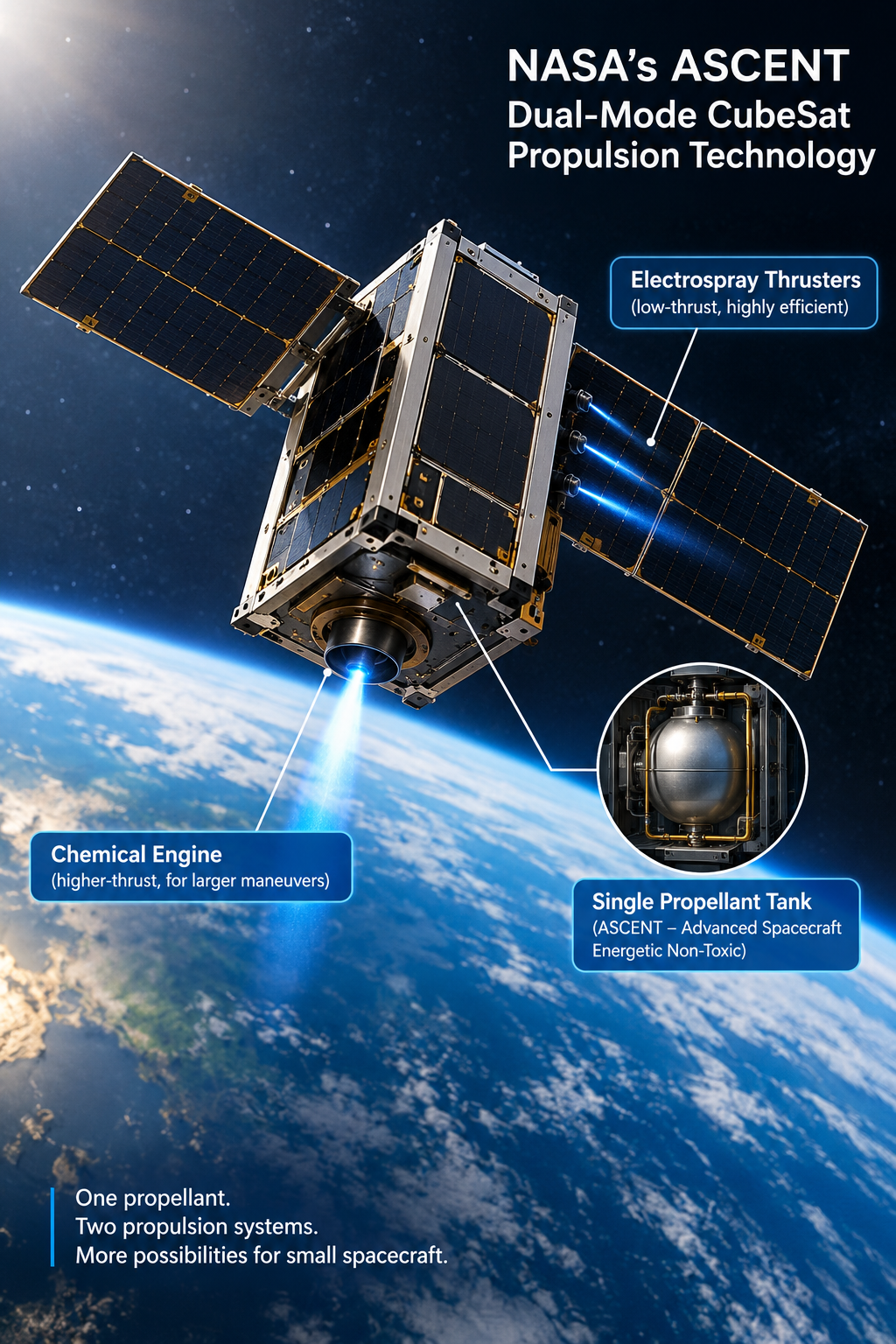
NASA is testing a potential answer with a new 6U CubeSat called the ASCENT Propulsion Dual Mode mission. The spacecraft is designed to demonstrate two different types of propulsion using the same propellant and a common tank and feed system.
The technology combines a higher-thrust chemical propulsion system with much more fuel-efficient electrospray thrusters. If the in-space demonstration works as planned, the approach could give future small spacecraft more flexibility to change or maintain their orbits while leaving more room for instruments and other mission hardware. NNASA+1
Article Focus and SEO Information
- Primary topic: NASA’s ASCENT dual-mode CubeSat propulsion technology
- Search intent: Informational — readers want to understand what NASA’s new CubeSat propulsion system does, why it matters, and how it could affect future satellites and space missions.
- Primary keyword: NASA CubeSat propulsion technology
- Secondary keywords: ASCENT propulsion, dual-mode propulsion, CubeSat propulsion system, NASA CubeSat technology, electrospray thrusters, green spacecraft propulsion, small satellite propulsion, satellite maneuvering
- Important facts requiring verification: Launch date and mission status should be rechecked immediately before publication because NASA currently lists the launch as no earlier than October 1, 2026. The spacecraft’s planned nine-month mission and its planned orbit-changing demonstrations should likewise be described as planned activities until they are completed. N
NASA
Why NASA Is Testing a New CubeSat Propulsion System
Spacecraft need propulsion for much more than simply leaving Earth.
Once a satellite reaches orbit, small thrusters can be used to adjust its altitude, maintain its orbit, control its orientation, or perform other maneuvers. Even in low Earth orbit, where satellites appear to move effortlessly around Earth, a small amount of atmospheric drag gradually changes their orbits.
Traditional spacecraft can use chemical propulsion when they need relatively strong thrust. Electric propulsion, meanwhile, can provide highly efficient but much smaller amounts of thrust.
The problem is that putting both systems on a small spacecraft can consume valuable mass, volume, plumbing, and other resources. NASA’s new demonstration is designed to test whether those functions can be combined around a single propellant system. NNASA+1
What Is NASA’s ASCENT Propulsion Dual Mode Mission?
The ASCENT Propulsion Dual Mode mission is a technology demonstration led by NASA’s Marshall Space Flight Center in Huntsville, Alabama.
The spacecraft is a 6U CubeSat, a standardized small-satellite form factor. NASA describes the spacecraft as being about the size of a large shoebox.
Its main purpose is not to perform a conventional science mission. Instead, it will demonstrate whether two different propulsion approaches can work together while using the same Advanced Spacecraft Energetic Non-Toxic (ASCENT) propellant.
NASA plans to feed the propellant from one central tank to:
- A higher-thrust chemical engine
- Low-thrust electrospray thrusters
This arrangement is intended to reduce the amount of propulsion hardware required compared with carrying completely separate propulsion systems. NNASA+1
What Is ASCENT Propellant?
ASCENT stands for Advanced Spacecraft Energetic Non-Toxic. It is a lower-toxicity spacecraft propellant developed as an alternative to traditional hydrazine-based propulsion.
ASCENT has already been demonstrated as a chemical propellant. NASA’s Green Propellant Infusion Mission successfully tested it in space, and the propellant was later used on NASA’s Lunar Flashlight mission. NNASA+1
NASA’s small-spacecraft technology documentation describes ASCENT as an ionic-liquid monopropellant and notes that it can offer higher performance characteristics than hydrazine, although it also has engineering challenges such as higher required catalyst temperatures. NNASA
The new dual-mode demonstration takes the idea further by testing ASCENT with two different propulsion methods.
How Does Dual-Mode Propulsion Work?
The easiest way to understand the system is to think of it as giving a spacecraft two different gears.
High-thrust chemical propulsion
The chemical propulsion system is designed to provide stronger thrust for maneuvers that require a relatively large change in velocity.
A chemical thruster converts the energy in the propellant into thrust. For a small spacecraft, this capability can be useful when the vehicle needs to change its orbit rather than simply make extremely small adjustments.
Low-thrust electrospray propulsion
Electrospray propulsion works differently.
Instead of relying on conventional combustion, an electric field is used to accelerate charged particles from a propellant. The resulting thrust is very small compared with a conventional chemical engine, but the system can use propellant extremely efficiently.
That makes low-thrust electric propulsion useful for longer-duration maneuvers where the spacecraft can gradually change its orbit.
NASA’s GPDM technical documentation describes the concept as combining a chemical thruster with four electrospray thrusters while using a common propellant tank and feed system. NNASA Technical Reports Server+1
Why Use One Propellant Tank?
This is one of the most important parts of the technology.
A spacecraft carrying separate propulsion systems may need separate tanks, feed lines, valves, and supporting hardware. For a large spacecraft, the additional mass and volume may be manageable.
For a CubeSat, every part of the spacecraft has to earn its place.
NASA says the dual-mode concept can save mass and volume by allowing both propulsion methods to use the same propellant and central tank. The space saved could potentially be used for scientific instruments or other spacecraft systems. NNASA
That does not mean future satellites will automatically become smaller or cheaper. The technology still needs to demonstrate that the integrated system can operate reliably in space.
Who Is Building the Technology?
NASA Marshall is managing the mission, but the project involves several organizations.
According to NASA, the spacecraft includes:
- MIT-developed electrospray thrusters
- A chemical propulsion module developed by Plasma Processes
- A spacecraft bus integrated by the Georgia Institute of Technology
This combination brings together NASA, academic, and commercial expertise in a single small-spacecraft technology demonstration. NNASA
What Tests Has the CubeSat Completed?
Before a propulsion system can operate in orbit, engineers need to make sure the spacecraft can survive launch and the extreme conditions of space.
NASA reports that the ASCENT propulsion CubeSat has undergone several major tests.
Thermal-vacuum testing
A thermal-vacuum test places spacecraft hardware inside a chamber that reproduces the vacuum and temperature conditions expected in space.
This allows engineers to check whether the spacecraft’s systems continue to operate under conditions that cannot be easily reproduced in a normal laboratory.
Leak testing
Because the spacecraft uses a shared propellant tank and feed system, preventing leaks is particularly important.
NASA says engineers performed pressurized helium leak testing to verify the integrity of the spacecraft’s seals and propulsion system. NNASA
Spin testing
Engineers also performed a spin test to measure the spacecraft’s mass properties and center of gravity.
These measurements help verify that the spacecraft can maintain stable flight and correctly point its antennas and solar panels.
NASA says the major environmental and physical testing has now been completed, with final system checkouts and preparation for launch remaining. NNASA
When Will the CubeSat Launch?
As of September 30, 2026, NASA says the ASCENT Propulsion Dual Mode mission is manifested for launch no earlier than October 1, 2026 aboard a SpaceX Falcon 9 from Vandenberg Space Force Base in California. NNASA
Publication note: This launch status should be checked again before publishing or updating this article because a “no earlier than” date is a target, not a guarantee that the launch will occur on that date.
What Will NASA Test in Orbit?
After deployment, NASA plans for the spacecraft to operate in an orbit about 325 miles (roughly 523 kilometers) above Earth.
The planned mission duration is about nine months.
Following initial spacecraft checkouts, operators are expected to perform chemical and electric propulsion maneuvers. The mission is designed to demonstrate orbit-raising and orbit-lowering maneuvers while switching between the two propulsion modes. NNASA
The key question is simple: Can one propellant system reliably support both high-thrust chemical propulsion and efficient low-thrust electrospray propulsion in space?
The flight demonstration is intended to provide an answer.
What Could This Mean for Future Satellites?
If the technology performs successfully, it could influence the design of future small spacecraft.
More maneuverable CubeSats
Many CubeSats are constrained by their limited size and propulsion capabilities. A compact dual-mode system could give some future spacecraft greater control over their orbits.
More efficient use of spacecraft mass
Reducing duplicate tanks and propulsion hardware could free up mass and volume for other equipment.
That could be particularly valuable for missions where every kilogram matters.
More flexible missions
A spacecraft that combines higher thrust with efficient low thrust could potentially perform a wider range of maneuvers than a spacecraft limited to only one propulsion method.
NASA’s technical work on GPDM identifies potential applications ranging from low Earth orbit to lunar and interplanetary missions, although those future applications would require additional development and mission-specific validation. NNASA Technical Reports Server+1
Could This Technology Help Missions to the Moon or Mars?
Potentially, but it is important not to overstate what this single demonstration proves.
NASA’s technical documentation identifies lunar and interplanetary missions as possible future applications for dual-mode small-spacecraft propulsion. The combination of chemical and electrospray propulsion could provide different types of maneuvering capability in a single spacecraft architecture. NNASA Technical Reports Server+1
However, demonstrating the technology on a CubeSat in low Earth orbit would not by itself prove that the system is ready for a mission to Mars or another distant destination.
Deep-space missions introduce additional challenges involving communications, power, navigation, thermal conditions, radiation, mission duration, and propulsion requirements.
The value of the current demonstration is that it can provide flight experience with the underlying propulsion concept.
How Is This Different From NASA’s Other Small-Satellite Propulsion Work?
NASA is developing and testing several approaches to making small spacecraft more capable.
For example, the DUPLEX CubeSat began an in-space test in December 2025 using two micropropulsion technologies based on polymer materials. NASA says DUPLEX is designed to demonstrate orbit-raising and orbit-lowering capabilities and long-duration orbital maneuvering. NNASA
NASA is also developing DiskSat, another small-spacecraft concept. NASA says electric propulsion on DiskSat can support precise orbit maneuvering, including orbit maintenance, orbit raising and lowering, and end-of-life deorbiting. NNASA
The ASCENT dual-mode concept is distinctive because it focuses on using one propellant and a common feed system for two different propulsion modes.
What This Development Means for Space Exploration
The broader importance of the technology is not simply that one CubeSat may be able to move more efficiently.
Small spacecraft are increasingly being considered for scientific investigations, technology demonstrations, Earth observation, communications, and missions beyond low Earth orbit. NASA’s 2026 State-of-the-Art Small Spacecraft Technology report notes continuing advances in small-spacecraft propulsion, avionics, communications, autonomy, and orbital transportation. NNASA
Propulsion remains one of the fundamental limitations for small spacecraft. Improving it could make future spacecraft more maneuverable without requiring them to become dramatically larger.
The ASCENT demonstration is therefore best viewed as a technology test with potentially broader applications, rather than a finished propulsion system ready for every future satellite.
Key Facts
- Mission: ASCENT Propulsion Dual Mode
- Technology: Dual-mode chemical and electrospray propulsion
- Spacecraft: 6U CubeSat
- Propellant: Advanced Spacecraft Energetic Non-Toxic (ASCENT)
- Common system: One propellant tank and feed system for both propulsion modes
- Lead NASA center: NASA Marshall Space Flight Center
- Electrospray thrusters: Developed by MIT
- Chemical propulsion module: Developed by Plasma Processes
- Spacecraft bus: Integrated by Georgia Tech
- Planned orbit: About 325 miles (523 km) above Earth
- Planned mission duration: About nine months
- Launch status as of September 30, 2026: No earlier than October 1, 2026, aboard a SpaceX Falcon 9 from Vandenberg Space Force Base
- Primary purpose: Demonstrate dual-mode propulsion in space N
Frequently Asked Questions
What is NASA’s new CubeSat propulsion technology?
NASA’s ASCENT Propulsion Dual Mode mission is testing a 6U CubeSat that uses the same ASCENT propellant for both a chemical propulsion system and low-thrust electrospray thrusters. NNASA
What is ASCENT propellant?
ASCENT stands for Advanced Spacecraft Energetic Non-Toxic. It is a lower-toxicity spacecraft propellant developed as an alternative to conventional hydrazine propulsion. NASA has previously demonstrated ASCENT in space. NNASA+1
Why does the CubeSat need two propulsion systems?
Chemical propulsion can provide higher thrust, while electric propulsion can provide highly efficient, low-thrust maneuvering. Combining them could give a small spacecraft access to both types of capability. NNASA+1
What is an electrospray thruster?
An electrospray thruster uses electrical forces to accelerate charged particles from a propellant and create thrust. The thrust is small, but the approach can be highly propellant-efficient, making it useful for long-duration maneuvers.
How big is the NASA spacecraft?
The ASCENT Propulsion Dual Mode spacecraft is a 6U CubeSat, which NASA describes as approximately the size of a large shoebox. NNASA
When is the CubeSat supposed to launch?
NASA currently lists the mission for launch no earlier than October 1, 2026, on a SpaceX Falcon 9 from Vandenberg Space Force Base. This date should be rechecked for any later launch updates. NNASA
Could this technology be used on Moon or Mars missions?
NASA technical studies identify lunar and interplanetary missions as potential future applications for dual-mode small-spacecraft propulsion. However, the current demonstration is intended to validate the technology in low Earth orbit, so future deep-space use would require additional testing and mission-specific development. NNASA Technical Reports Server+1
Conclusion
NASA’s ASCENT Propulsion Dual Mode mission is testing an important idea for the future of small spacecraft: one propellant system could potentially provide both strong chemical thrust and highly efficient electric propulsion.
For CubeSats, where mass and internal space are tightly limited, combining those capabilities could make spacecraft more flexible and easier to design for complex missions.
The upcoming flight demonstration will be the critical next step. If the system performs as intended in orbit, it could provide engineers with valuable flight experience for future small-satellite propulsion systems.
For now, the technology should be viewed as a demonstration rather than a proven replacement for conventional satellite propulsion. Its significance will depend on what NASA learns when the two propulsion modes are operated in space.
SEO Metadata
SEO Meta Title:
NASA’s New CubeSat Propulsion Technology Explained
SEO Meta Description:
NASA is testing a 6U CubeSat with dual-mode propulsion using ASCENT fuel, combining chemical and electrospray thrusters for flexible satellite maneuvering.
SEO URL Slug:nasa-cubesat-propulsion-technology-ascent
Suggested Internal-Link Anchor Texts
- How CubeSats Work
- What Is Electric Propulsion?
- NASA’s Small Satellite Missions
- How Satellites Stay in Orbit
- What Is a 6U CubeSat?
- NASA’s Green Propellant Technology
- How Spacecraft Change Orbit
- The Future of Small Satellites
Suggested Reliable External Sources
- NASA — NASA Tests Dual Mode Propulsion CubeSat Ahead of Launch
NASA mission article - NASA — 2026 State-of-the-Art of Small Spacecraft Technology
NASA Small Spacecraft Technology report - NASA Technical Reports Server — Green Propulsion Dual Mode Mission
NASA Technical Reports Server - NASA — In-Space Propulsion Technology
NASA In-Space Propulsion overview - NASA — Green Propellant Infusion Mission
NASA Green Propellant Infusion Mission