

For much of the world, getting reliable high-speed internet still depends on something very familiar: cables, fiber networks, cell towers, or other infrastructure on the ground.
But what happens when that infrastructure is too expensive or difficult to build?
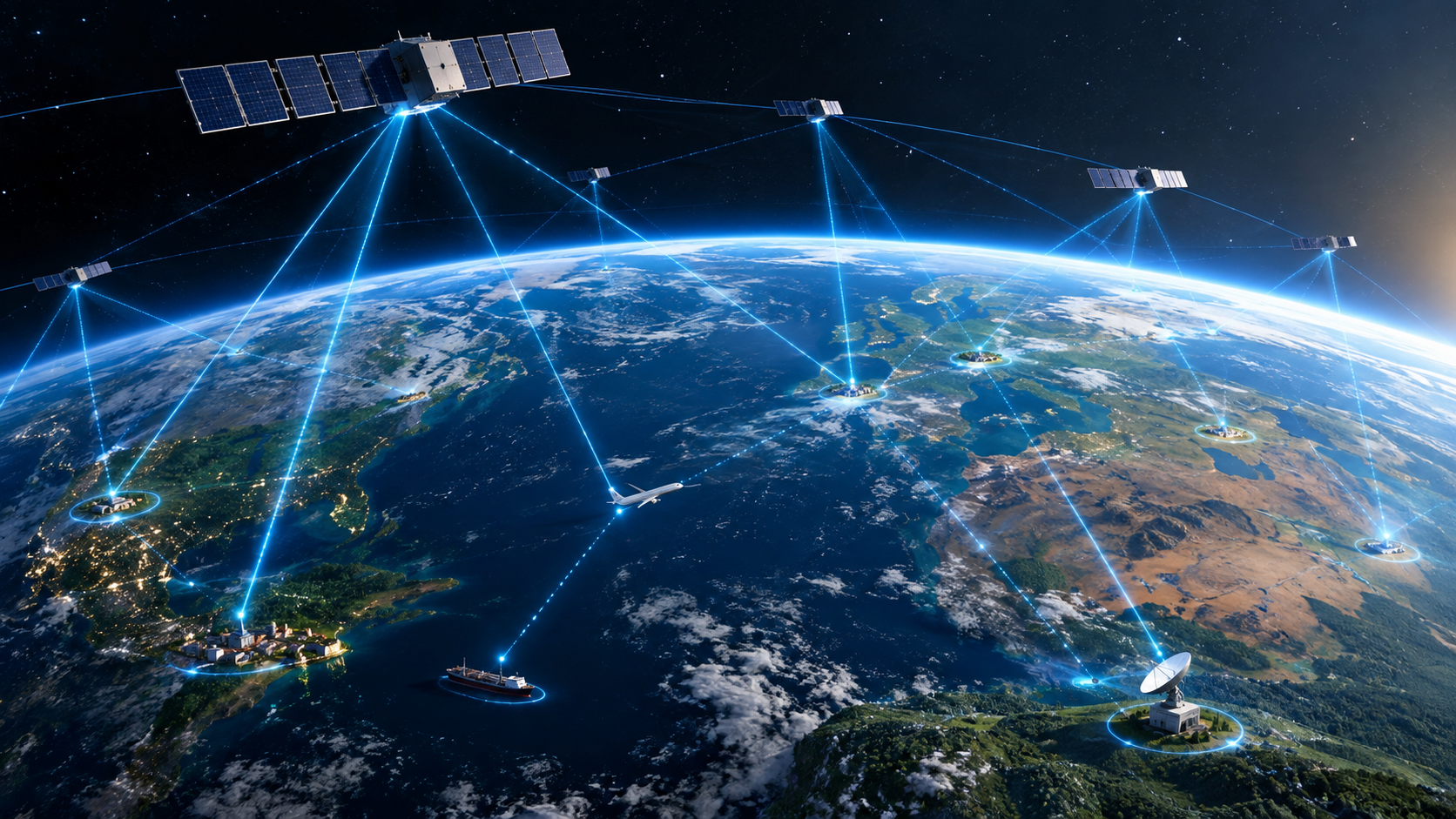
Mountains, deserts, islands, oceans, remote communities, and disaster zones can all present major challenges for conventional networks. SpaceX’s Starlink satellite network is taking a different approach: putting thousands of internet satellites in low Earth orbit and connecting users from space.
The result is a satellite-internet system that can provide broadband service in locations where traditional connections may be limited or unavailable.
Starlink is not simply another satellite internet service. Its large low-Earth-orbit constellation, frequent satellite launches, ground infrastructure, phased-array antennas, and increasingly capable spacecraft have created a fundamentally different approach to delivering internet connectivity.
Here’s how the system works, why low Earth orbit matters, and what Starlink could mean for the future of global communications.
What Is Starlink?
Starlink is a satellite broadband network operated by SpaceX.
Instead of relying primarily on one or a few very large satellites positioned far from Earth, Starlink uses a large constellation of satellites in low Earth orbit (LEO).
SpaceX says its Starlink satellites operate at around 550 kilometers above Earth in its current network architecture. By comparison, traditional geostationary communications satellites operate roughly 35,786 kilometers above the equator. SStarlink+1
That difference in altitude is extremely important.
A signal traveling between Earth and a satellite in low orbit has a much shorter distance to cover. This can significantly reduce latency, which is the delay between sending data and receiving a response.
How Starlink Satellites Deliver Internet
A Starlink connection involves several pieces working together.
A customer uses a Starlink user terminal, sometimes called a satellite dish, to communicate with satellites passing overhead.
The satellite then connects the user’s traffic into Starlink’s broader network, which includes ground stations and internet connection points. SpaceX has also developed optical inter-satellite links, commonly called laser links, that allow some Starlink satellites to communicate directly with other satellites in space. SStarlink
In simplified form, the process looks like this:
User device → Starlink router → User terminal → Starlink satellite → Ground network or satellite-to-satellite link → Internet
The exact path can vary depending on network conditions and location.
Why the satellites need to work as a constellation
A single satellite cannot provide continuous coverage everywhere on Earth.
Starlink instead uses many satellites moving around Earth. As one satellite moves away from a user’s location, another can take over the connection.
This requires sophisticated software, antennas, satellite tracking, and network management to coordinate the constantly moving spacecraft.
Why Low Earth Orbit Makes Such a Difference
Traditional geostationary satellite internet has historically faced a major technical limitation: distance.
A geostationary satellite must orbit extremely far from Earth to remain apparently fixed over one location. That creates a long signal path between the user and satellite.
Starlink’s much lower orbit reduces this distance.
SpaceX says Starlink can achieve around 25 milliseconds of latency in its network architecture, compared with 600+ milliseconds for traditional geostationary satellite systems in its comparison. Actual Starlink performance varies by location, network conditions, service plan, and other factors. SStarlink
Starlink’s current specifications say users typically experience 25–220 Mbps download speeds and 5–20 Mbps upload speeds, while land-based latency is typically 25–60 milliseconds. Remote locations can experience higher latency. SStarlink
This lower latency is particularly important for activities such as:
- Video calls
- Cloud applications
- Online gaming
- Remote work
- Streaming
- Web browsing
How Starlink Is Expanding Access to Remote Areas
One of the most important effects of satellite internet is that the physical network does not have to reach every home.
A fiber-optic network requires physical infrastructure to be constructed between locations. A cellular network requires towers and supporting infrastructure.
Starlink’s approach moves a significant portion of that infrastructure into space.
A customer generally needs a Starlink terminal with a suitable view of the sky and an authorized service area. The satellite network then provides the connection from above.
Starlink says its service can cover land, oceanic, and polar regions, subject to regulatory authorization in individual countries. SStarlink
That creates possibilities for communities and organizations that are difficult to connect using conventional terrestrial infrastructure.
Starlink’s Growing Global Reach
The scale of Starlink’s network has changed rapidly.
In its 2025 progress report, SpaceX reported more than 9 million customers and service in 155+ countries and markets. The company also said it added more than 4.6 million active customers during 2025 and expanded service to 35 additional countries, territories, and markets that year. SStarlink
These numbers are company-reported and can change quickly as new satellites launch and regulatory approvals expand.
Starlink’s growth illustrates a broader change in satellite communications: satellites are increasingly being deployed not as isolated spacecraft, but as large, continuously evolving networks.
The Technology Behind Starlink
Starlink’s capabilities depend on much more than the satellites themselves.
Phased-array antennas
Starlink satellites and user terminals use electronically steered antenna technology.
A phased-array antenna can electronically direct communication beams without relying on a traditional mechanically rotating dish.
On the satellite side, these beams allow the spacecraft to communicate with different areas on Earth and manage connections dynamically.
Optical inter-satellite links
Some Starlink satellites use laser-based communication links to communicate with other satellites.
These links can allow information to travel through space between satellites rather than always passing through a ground station.
SpaceX says its Starlink architecture uses optical inter-satellite links with capacity of more than 100 Gbps. SStarlink
This capability is particularly useful for connecting remote areas where a direct satellite-to-ground path may not always be available.
Compact satellite design
Starlink satellites are designed as relatively compact, flat-panel spacecraft.
SpaceX says the flat-panel design reduces volume and allows many satellites to be packed into a launch vehicle, helping the company deploy large numbers of spacecraft. SStarlink
That launch strategy is a major part of the Starlink model.
Starlink Is More Than Home Internet
The network is increasingly being used in situations beyond residential broadband.
Starlink’s 2025 progress report says its network had served more than 21 million airline passengers and 20 million cruise passengers. SStarlink
The company also offers mobility-oriented services for locations such as vehicles, aircraft, ships, and other moving platforms.
This is important because traditional broadband infrastructure is fixed to particular locations. Satellite connectivity can travel with the user.
Starlink Direct to Cell Could Expand Connectivity Again
One of the most significant developments is Starlink Direct to Cell.
Instead of requiring a dedicated Starlink terminal, Direct to Cell is designed to connect specially equipped Starlink satellites directly with compatible ordinary mobile phones through partnerships with cellular operators.
SpaceX describes the satellites as effectively functioning like cell towers in space. SStarlink
The technology is particularly interesting for areas without terrestrial cellular coverage.
In its 2025 progress report, SpaceX said the first-generation Direct to Cell constellation had been deployed and that more than 650 satellites had been launched for the system in 18 months. The company said the service had connected more than 12 million people at least once. SStarlink
The practical significance is straightforward: the boundary between satellite communications and ordinary mobile networks is becoming less distinct.
Starlink V3: The Next Generation of Satellites
SpaceX is also developing a newer generation of Starlink spacecraft.
The company’s published specifications for Starlink V3 describe satellites designed for substantially greater capacity than earlier versions.
SpaceX lists approximately:
- 1 Tbps of downlink capacity
- 160 Gbps of uplink capacity
- 2,048 downlink and uplink beams
SpaceX says these represent roughly 10 times the downlink and 22 times the uplink capacity of its V2 satellite design. SStarlink
These are design specifications rather than measurements of what every customer will experience.
Higher satellite capacity matters because Starlink is not simply trying to connect more locations. It also needs to provide sufficient bandwidth as the number of users grows.
What Are the Benefits of Starlink?
Starlink’s satellite architecture provides several potential advantages.
Coverage in difficult locations
Satellite networks can reach places where laying fiber or building extensive terrestrial infrastructure is difficult.
Lower latency than traditional satellite internet
Because Starlink satellites operate much closer to Earth, they can offer substantially lower latency than conventional geostationary satellite systems. SStarlink
Rapid network expansion
New satellites can be launched and integrated into the constellation as the network expands.
Connectivity during infrastructure disruptions
Satellite connections can be useful when terrestrial infrastructure is damaged by disasters or other events, although actual availability depends on power, equipment, network conditions, and local authorization.
Mobility
Ships, aircraft, vehicles, and remote operations can use satellite connectivity without needing a fixed terrestrial broadband connection.
What Are the Limitations?
Starlink is not a replacement for every type of internet connection.
It needs suitable equipment
Most Starlink services require a user terminal, power, and an unobstructed enough view of the sky for reliable operation. SStarlink
Performance varies
Starlink’s published specifications explicitly state that actual speeds can be lower than expected, particularly during periods of high usage, and that performance varies according to location, time, and service plan. SStarlink
Regulatory restrictions matter
Satellite coverage does not automatically mean that service is legally available everywhere. Starlink’s own coverage information notes that service is subject to authorization in individual countries. SStarlink
Space sustainability remains important
A constellation containing thousands of satellites creates additional demands for collision avoidance, spacecraft tracking, orbital management, and responsible end-of-life disposal.
SpaceX says Starlink satellites are designed to be demisable, meaning they are intended to burn up during atmospheric reentry. The company also publishes satellite trajectory information and provides tools for conjunction screening. SStarlink+1
Astronomy concerns
Large satellite constellations can affect astronomical observations, particularly because satellites can reflect sunlight and appear as moving objects in the night sky.
SpaceX says it has worked with organizations including the National Science Foundation and National Radio Astronomy Observatory on techniques intended to reduce interference with astronomical observations. SStarlink
The broader issue remains an important part of discussions about the future of large satellite constellations.
How Starlink Could Change the Future of Global Internet Access
The biggest change may not be a single new satellite or faster internet connection.
It is the idea that internet infrastructure can increasingly exist in space.
For decades, expanding internet access generally meant building more infrastructure on the ground. Satellite constellations introduce another model in which connectivity can be extended over huge geographic areas without constructing a continuous physical network between every user and the wider internet.
That could be especially valuable for:
- Remote communities
- Ships and aircraft
- Rural businesses
- Scientific expeditions
- Emergency response
- Disaster recovery
- Remote industrial operations
- Areas with limited terrestrial broadband
Starlink’s growing Direct to Cell program could extend this concept further by connecting ordinary mobile devices directly to satellites.
What This Means for Space Technology
Starlink is also changing how commercial satellites are designed and operated.
Rather than treating satellites as expensive, individually managed spacecraft that remain in service for many years without major upgrades, Starlink uses a more iterative approach.
New generations can introduce improved antennas, computing systems, power systems, communications hardware, and network capabilities.
SpaceX says its V3 satellites will substantially increase capacity, while its Direct to Cell development is adding satellite communications capabilities designed to interact with terrestrial cellular networks. SSpaceX+1
This combination of mass production, frequent launches, spacecraft upgrades, and network-scale operations is one of the defining features of the Starlink model.
The Bigger Picture
Starlink’s impact goes beyond making satellite internet faster.
It is helping demonstrate that large low-Earth-orbit constellations can become a major part of global communications infrastructure.
The system combines spacecraft, rockets, ground stations, antennas, software, optical links, spectrum, and terrestrial internet infrastructure into one network.
The technology is still developing, and Starlink faces challenges involving capacity, regulation, space safety, astronomy, affordability, and network management.
But the basic idea has already changed the satellite communications industry: instead of bringing the internet to remote places by building more cables and towers alone, it is also possible to bring part of the network overhead.
Key Facts
- Operator: SpaceX
- Network: Starlink
- Orbit: Low Earth orbit
- Typical Starlink orbital altitude: About 550 km for the current network architecture
- Reported customers: 9 million+ in SpaceX’s 2025 progress report
- Reported markets: 155+ countries and markets in the 2025 report
- Typical published land latency: 25–60 ms
- Typical published download range: 25–220 Mbps
- Key technologies: Phased-array antennas, satellite networking, optical inter-satellite links, reusable launch infrastructure
- Additional service: Starlink Direct to Cell
- Next-generation spacecraft: Starlink V3
- Main purpose: Broadband connectivity from low Earth orbit
Figures such as customer numbers, satellite counts, coverage, speeds, and availability can change frequently, so they should be updated before publication. SStarlink+1
Frequently Asked Questions
What is Starlink?
Starlink is SpaceX’s satellite internet network. It uses a large constellation of satellites in low Earth orbit to provide broadband internet connectivity to users on Earth and, through specialized services, to mobile and other moving platforms.
How do Starlink satellites provide internet?
A Starlink user terminal communicates with satellites overhead. The user’s traffic is then routed through Starlink’s satellite and ground network, with some satellites also able to communicate with each other using optical links. SStarlink
Why is Starlink faster than traditional satellite internet?
One major reason is orbital altitude. Starlink satellites operate much closer to Earth than geostationary communications satellites, reducing the distance signals must travel and therefore reducing latency. SStarlink
Can Starlink provide internet anywhere in the world?
Starlink has expanded to many countries, territories, and other markets, and SpaceX says its network can provide connectivity across land, oceans, and polar regions. However, service remains subject to regulatory authorization and local availability. SStarlink+1
What is Starlink Direct to Cell?
Direct to Cell is SpaceX’s satellite-to-mobile technology. It is designed to allow compatible ordinary mobile phones to connect to specially equipped Starlink satellites through partnerships with mobile network operators. SStarlink
What are Starlink V3 satellites?
Starlink V3 is a next-generation satellite design from SpaceX. The company says V3 satellites are designed for significantly greater communication capacity, including approximately 1 Tbps of downlink capacity and 160 Gbps of uplink capacity. SStarlink
Does Starlink have disadvantages?
Yes. Service requires appropriate equipment and a suitable view of the sky, performance varies by location and network conditions, and availability depends on local authorization. Large satellite constellations also raise space-safety and astronomy concerns that require ongoing management. SStarlink+1
Conclusion
SpaceX’s Starlink constellation is changing satellite internet by moving from a small number of distant communications satellites toward a large, continuously expanding network in low Earth orbit.
That architecture can provide lower latency than traditional geostationary satellite internet while reaching locations where terrestrial infrastructure is difficult to deploy.
The next phase could be even more significant. Higher-capacity V3 satellites and Direct to Cell technology are designed to expand what satellite networks can do, potentially bringing connectivity not only to homes and businesses but also directly to mobile devices and moving platforms.
Starlink does not eliminate the need for fiber, cellular networks, or other forms of terrestrial infrastructure. Instead, it adds a powerful new layer to the global communications system: a network in space that can connect places traditional infrastructure cannot easily reach.
SEO Metadata
SEO Meta Title:
Starlink Satellites: How They Change Internet Access
SEO Meta Description:
Learn how SpaceX Starlink satellites deliver fast, low-latency internet worldwide, connect remote areas, and advance satellite communication technology.
SEO URL Slug:starlink-satellites-global-internet-access
Suggested Internal-Link Anchor Texts
- How Starlink Satellites Work
- What Is Low Earth Orbit?
- How Satellite Internet Works
- SpaceX Falcon 9 Explained
- What Are Satellite Mega-Constellations?
- Starlink Direct to Cell Explained
- How Satellites Communicate With Earth
- The Future of Satellite Internet